CS – AI – The Student
As Computer Science teachers, we have a responsibility to ensure that students understand artificial intelligence, not simply how to use it.
There is a significant difference between a student who can write an effective prompt and one who understands why an AI system produces a particular response, recognises its limitations and can evaluate its reliability.
With AI increasingly integrated into programming environments, search engines and everyday technology, AI literacy needs to become a structured part of Computer Science education.
But what should that progression actually look like across secondary school?
I would argue that we need to move beyond teaching students how to use AI tools and focus instead on developing their computational understanding, critical thinking and technical independence.
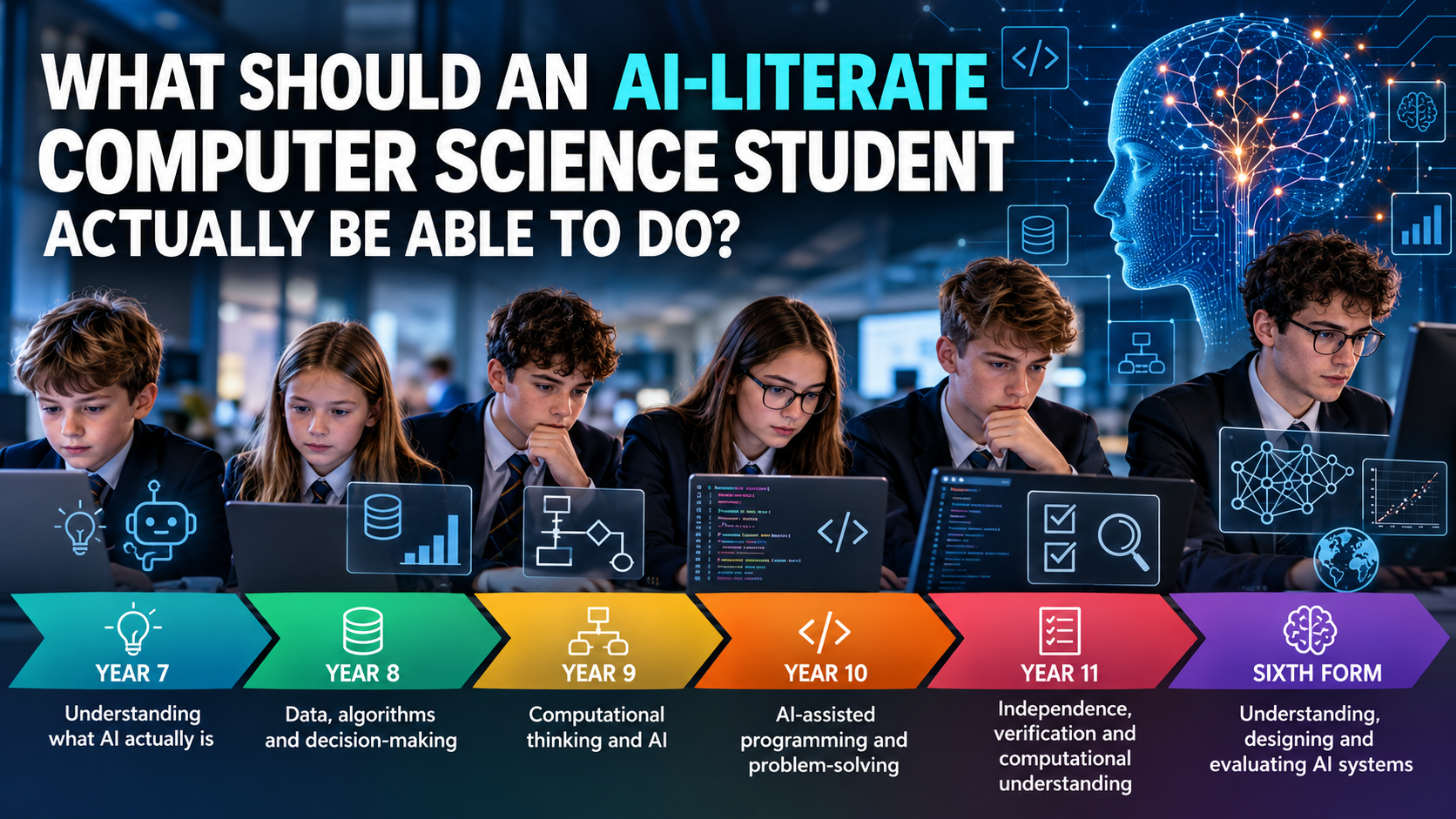
Year 7 (Ages 11–12): Understanding What AI Actually Is
At this stage, students should develop a basic understanding of artificial intelligence and how it differs from traditional computer programs.
Students should be able to:
- Explain the difference between a traditional rule-based program and an AI system.
- Recognise examples of AI in everyday technology.
- Understand that computers use data and algorithms to process information.
- Recognise that AI systems can generate incorrect results.
- Explain why AI does not think or understand information in the same way humans do.
- Understand that AI systems are designed and developed by people.
The key question: Can a student explain the difference between a program following explicitly written instructions and an AI system making predictions based on learned patterns?
Year 8 (Ages 12–13): Data, Algorithms and Decision-Making
Students should begin exploring how data influences the behaviour of AI systems.
Students should be able to:
- Understand how training data is used in machine learning.
- Recognise how the quality of data affects the quality of outputs.
- Identify examples of bias in datasets.
- Explore simple classification and prediction systems.
- Understand that AI systems can produce different outputs depending on their training.
- Recognise the importance of data privacy and responsible data collection.
The key question: Can a student explain how biased or incomplete training data might lead to an unreliable AI prediction?
Year 9 (Ages 13–14): Computational Thinking and AI
By Year 9, students should begin connecting AI concepts to the computational thinking skills they have developed.
Students should be able to:
- Apply decomposition, abstraction and pattern recognition to problems involving AI.
- Understand the distinction between traditional algorithms and machine learning approaches.
- Experiment with simple machine learning models.
- Evaluate the accuracy of predictions using test data.
- Recognise overfitting and the limitations of small datasets at an introductory level.
- Consider whether AI is actually the most appropriate solution to a computational problem.
- Explain why an AI-generated solution may not always be the most efficient or reliable.
The key question: Can a student justify whether a problem requires AI or could be solved more effectively using a conventional algorithm?
Year 10 (Ages 14–15): AI-Assisted Programming and Problem-Solving
At GCSE level, students are developing more sophisticated programming skills.
This is where AI creates both opportunities and significant challenges.
Students should be able to:
- Use AI to explain unfamiliar programming concepts without relying on it to complete tasks.
- Critically evaluate AI-generated code.
- Identify syntax, logic and runtime errors in suggested solutions.
- Trace algorithms to establish whether AI-generated code behaves as expected.
- Test AI-generated solutions using appropriate test data.
- Recognise inefficient or unnecessarily complicated implementations.
- Understand why generating working code does not demonstrate programming competence.
- Apply examination and assessment rules governing the use of AI.
The key question: Can a student independently explain, trace, test and modify code generated by AI?
If they cannot, can we really say they understand the solution?
Year 11 (Ages 15–16): Independence, Verification and Computational Understanding
By the end of GCSE Computer Science, students should demonstrate that AI supports their development rather than replacing their problem-solving skills.
Students should be able to:
- Independently design algorithms using pseudocode or flowcharts.
- Compare their own solutions with AI-generated alternatives.
- Evaluate the efficiency, readability and maintainability of code.
- Recognise that AI-generated explanations can contradict an examination specification.
- Apply systematic testing and debugging techniques.
- Explain the security risks associated with blindly implementing AI-generated code.
- Understand the implications of using AI in assessed programming work.
- Demonstrate programming competence without AI assistance.
The key question: Can a student solve a computational problem independently and then use AI critically to evaluate or improve their solution?
Sixth Form (Ages 16–18): Understanding, Designing and Evaluating AI Systems
At A-level, students should develop an understanding of the underlying principles of AI rather than simply treating it as another application.
Students should be able to:
- Explain fundamental machine learning concepts, including supervised and unsupervised learning.
- Understand the principles behind neural networks and how models are trained.
- Explore the relationship between data structures, algorithms and AI systems.
- Evaluate training data, testing methods and model performance.
- Understand computational complexity and the resources required to develop and operate AI systems.
- Critically examine the security, privacy and ethical implications of AI.
- Evaluate how AI-generated code might introduce vulnerabilities or inefficient solutions.
- Make informed decisions about incorporating AI into software development workflows.
- Understand the importance of transparency, explainability and human accountability in automated systems.
- Develop and justify their own technical solutions while maintaining intellectual ownership.
The key question: Can a student explain how an AI system works, evaluate its limitations and make a technically informed decision about whether it should be used?
The Challenge for Computer Science Teachers
I think we need to be particularly careful about how AI changes the way students learn programming.
A student who asks ChatGPT to generate a Python solution and successfully runs the code has demonstrated very little about their own computational understanding.
The program might work perfectly.
But can they explain the algorithm?
Can they trace the variables?
Can they identify a logic error?
Can they modify the program to meet a new requirement?
Can they explain why one solution is more efficient than another?
If the answer is no, then AI has completed the programming task, but the student has not necessarily learned to program.
There is also a broader curriculum issue.
We are teaching students in an environment where artificial intelligence is fundamentally changing software development, yet much of our assessment still quite rightly requires students to demonstrate independent algorithmic thinking and programming competence.
The challenge is finding the balance.
Students need to understand how to work effectively with AI, but they must first develop the foundational knowledge required to recognise when AI is wrong.
Without that knowledge, they cannot meaningfully evaluate its output.
My Suggested AI Literacy Progression for Computer Science
AI literacy should develop progressively throughout secondary education, with each stage building on the computational understanding developed in previous years.
- Year 7: Understand what AI is.
- Year 8: Understand the importance of data.
- Year 9: Understand how AI approaches computational problems.
- Year 10: Critically evaluate AI-generated code.
- Year 11: Demonstrate independent computational thinking.
- Sixth Form: Understand, evaluate and responsibly integrate AI systems.
The progression should not be:
Better prompts → More AI-generated code → Faster programming
Instead, it should be:
Computational Understanding → Critical Evaluation → Technical Independence → Responsible AI Integration
Are We Developing AI Users or Computer Scientists?
Ultimately, the goal of Computer Science education should not be to produce students who can get AI to write increasingly complicated programs.
It should be to produce students who understand computing well enough to know when the AI-generated program is wrong.
And perhaps the most important question we should be asking is:
If we removed access to AI tomorrow, would our students still be able to think computationally, design algorithms and write code independently?
Because if they cannot, we may be developing competent AI users rather than competent Computer Scientists.
What Do You Think?
I’d be interested in hearing how other Computer Science teachers are approaching AI literacy across KS3, GCSE and A-level.
Are we explicitly teaching these skills, or are we assuming students will develop them simply through using AI?
Share your thoughts in the comments.