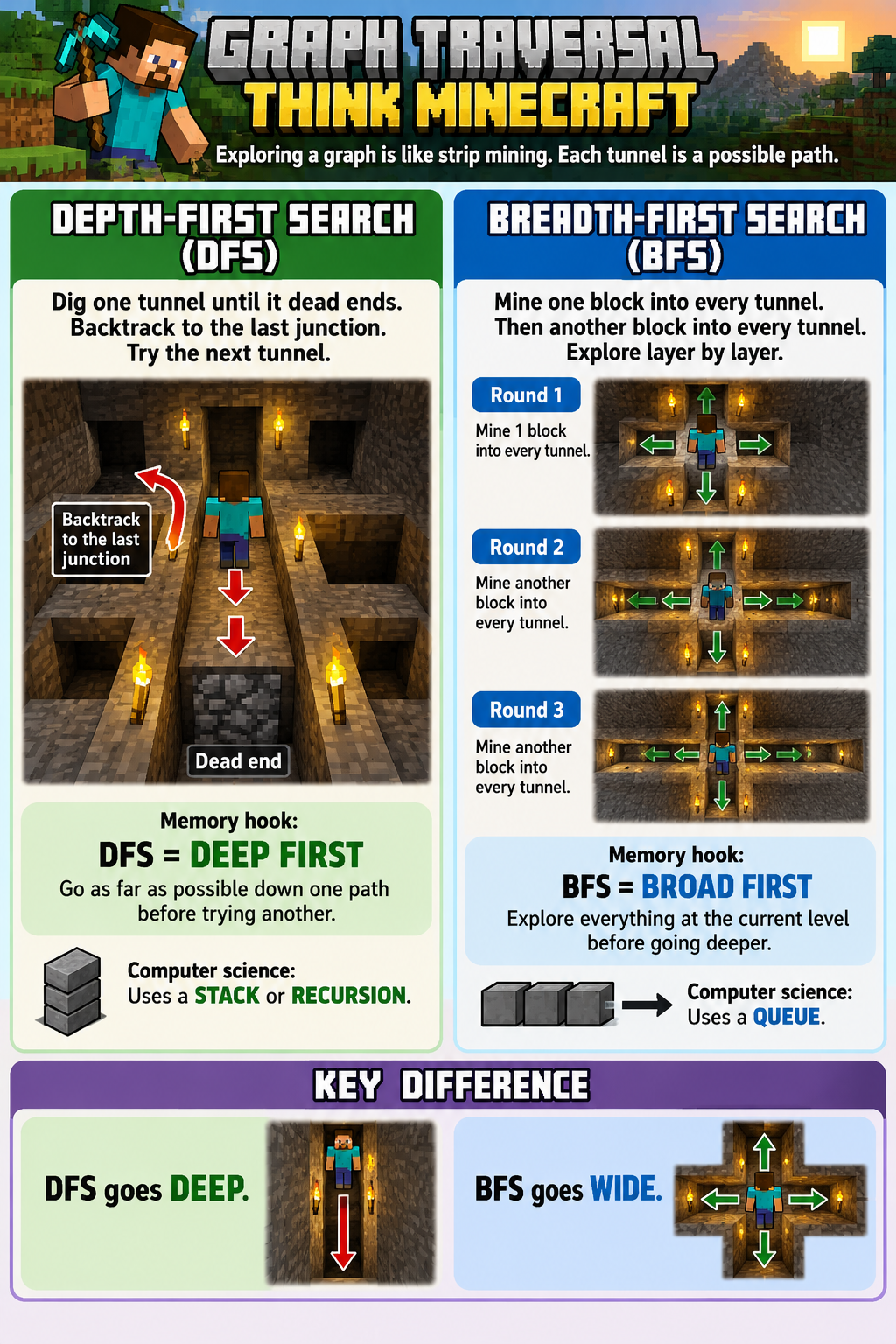
Minecraft for the win…
Breadth-first search. Depth-first search. Stacks. Queues. Backtracking.
For students encountering graph traversal for the first time, there is a lot of terminology to absorb before they have necessarily developed a picture of what the algorithms are actually doing.
And that is often the problem.
A student can learn that depth-first traversal uses a stack and breadth-first traversal uses a queue and still not really understand either algorithm.
Sometimes we don’t need to simplify the Computer Science. We just need to change the route into it.
For graph traversal, I think Minecraft provides a surprisingly effective route.
Think Minecraft
Imagine you are underground in Minecraft, strip mining.
You reach a point where there are several tunnels you could explore.
The question is: how are you going to explore them?
That is essentially the problem facing a graph traversal algorithm. We have nodes connected to other nodes, and we need a systematic way of visiting them.
Two different approaches give us Depth-First Search (DFS) and Breadth-First Search (BFS).
Depth-First Search: Pick a Tunnel and Keep Mining
Imagine choosing one of the tunnels and simply following it.
You keep mining.
And mining.
And mining.
You don’t worry about the other tunnels yet. You continue along your chosen route until eventually you cannot go any further.
You’ve reached a dead end.
What do you do?
You backtrack.
You return to the last junction where there was another unexplored tunnel and start exploring that one instead.
That is the basic idea behind Depth-First Search.
DFS = go DEEP.
In graph terminology, we explore as far as possible along one branch before backtracking.
Once students understand the Minecraft analogy, we can attach the formal Computer Science:
Depth-First Search → Stack → Backtracking
DFS can also be implemented recursively, with the program’s call stack effectively keeping track of where it needs to return.
The important thing is that the technical terminology now describes something the student can already visualize.
Breadth-First Search: Explore Around You First
Now imagine approaching the same mine differently.
This time, instead of disappearing hundreds of blocks down one tunnel, you explore the area immediately around you.
Mine a little way into the first tunnel.
Then the next.
Then the next.
Once you’ve explored everything immediately connected to your current position, you move another level outward.
Then another.
Then another.
Rather than going deep immediately, you’re gradually expanding the area you’ve explored.
That’s Breadth-First Search.
BFS = go WIDE.
In graph terminology, BFS visits nodes level by level, exploring the nodes closest to the starting point before those further away.
Now we can introduce its underlying data structure:
Breadth-First Search → Queue → Level-by-level exploration
Again, the terminology comes after the mental model.
DFS vs BFS
The distinction becomes remarkably simple:
| Depth-First Search | Breadth-First Search |
|---|---|
| Go deep | Go wide |
| Follow one path | Explore the current level |
| Backtrack when necessary | Gradually move outward |
| Uses a stack / recursion | Uses a queue |
| Think: one Minecraft tunnel | Think: all nearby Minecraft tunnels |
That gives students something much more memorable than two definitions on a PowerPoint slide.
But Why Does DFS Use a Stack?
This is where I think the analogy becomes particularly useful.
Imagine travelling down a Minecraft mine:
Entrance → Junction A → Junction B → Junction C
At Junction C, you hit a dead end.
Where do you return?
Junction B.
After dealing with B, you may return to A.
The last junction you encountered is the first one you need to return to.
That is exactly the behaviour of a stack:
Last In, First Out (LIFO).
Suddenly, the fact that DFS uses a stack isn’t an isolated fact students have to memorize. It follows logically from the way they have imagined exploring the mine.
And Why Does BFS Use a Queue?
Breadth-first traversal has a different problem.
As we discover new places to explore, we effectively add them to a waiting list.
If we discover A, then B, then C, we explore them in that same order:
A → B → C
That’s:
First In, First Out (FIFO).
Which is precisely how a queue operates.
Again, the data structure isn’t something arbitrary that students simply need to remember. It serves the behaviour required by the algorithm.
Mental Model First, Terminology Second
There is a broader pedagogical point here.
Computer Science contains an enormous amount of abstraction.
We teach stacks, queues, trees, graphs, recursion, pointers, protocols, addressing and algorithms — often using terminology that makes perfect sense once you understand the concept but provides very little help when encountering it for the first time.
There can therefore be a temptation to begin with the formal definition because that is ultimately what students need for the examination.
But perhaps the order should sometimes be reversed.
Start with the mental model.
Let the student understand what is happening.
Then introduce the terminology.
Then formalize it.
Then move to pseudocode, tracing and examination questions.
The analogy isn’t replacing the Computer Science. It is providing a scaffold that allows students to reach it.
From Minecraft to the Exam
Of course, students eventually need to move beyond Minecraft.
I wouldn’t want a student writing:
“DFS is when Steve keeps mining until he hits bedrock.”
in an examination.
The analogy has done its job once the student can translate their understanding into appropriate terminology:
Depth-first traversal explores as far as possible along a branch before backtracking. It can be implemented using a stack or recursion.
And:
Breadth-first traversal explores all adjacent nodes before progressing to the next level and typically uses a queue.
Now those definitions mean something.
The student isn’t simply recalling a sentence.
They have a picture behind it.
Sometimes We Just Need a Different Route
One of the challenges of teaching Computer Science is maintaining the rigor of the subject while making highly abstract ideas accessible.
Those two goals aren’t opposites.
We don’t always need to make the Computer Science easier.
Sometimes we just need to change the route into it.
And occasionally, that route happens to run straight through a Minecraft mine.
⛏️