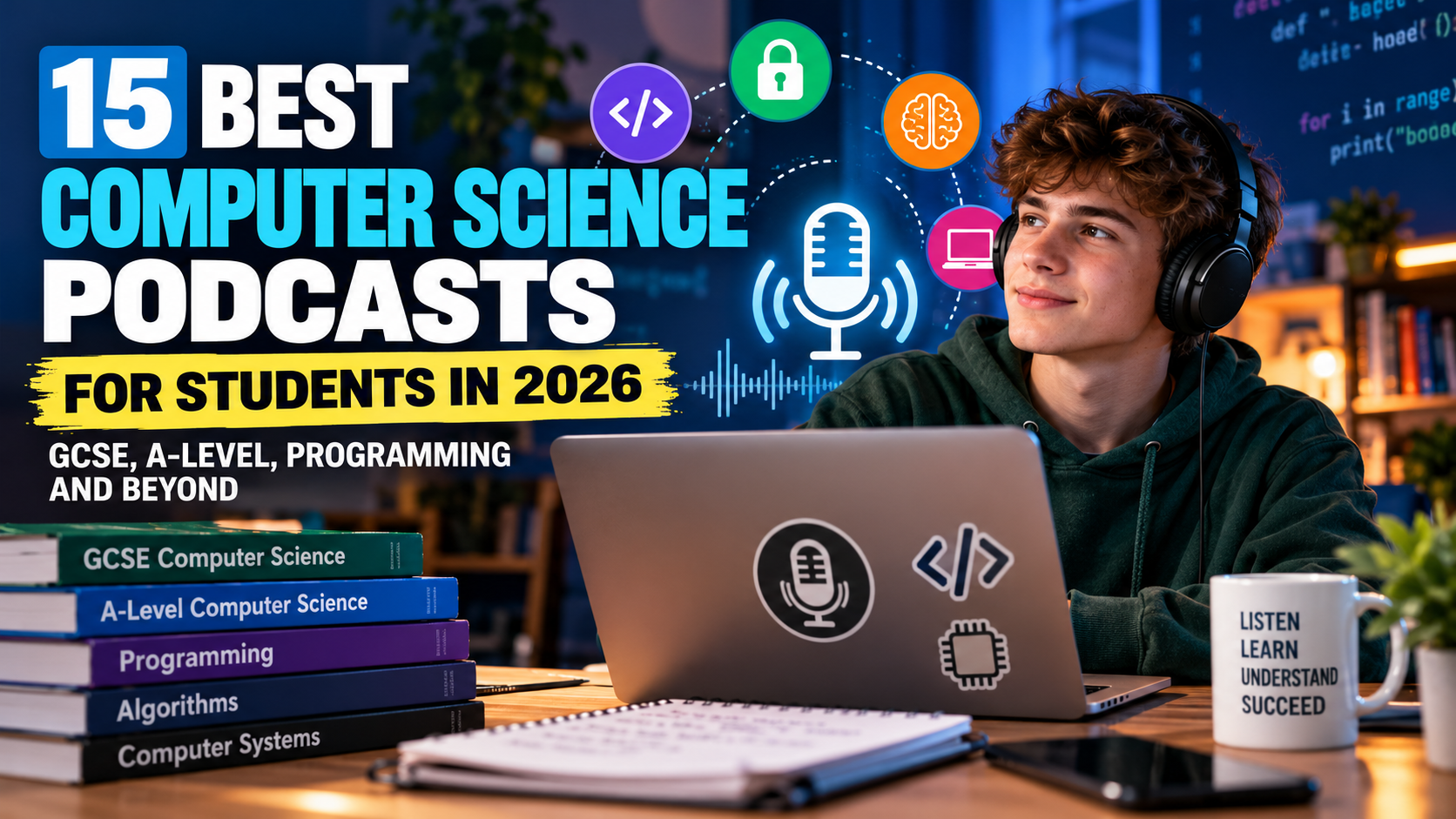
Looking for the best Computer Science podcasts?
Looking for the best Computer Science podcasts? Discover 15 fantastic podcasts covering GCSE and A-Level revision, programming, cybersecurity, artificial intelligence and careers in technology.
Computer Science is one of the most exciting subjects to study. From artificial intelligence and cybersecurity to software development and the algorithms that shape our digital world, computing is transforming how we live, work and communicate.
But Computer Science can also be challenging.
Understanding binary arithmetic, computer architecture, programming techniques, algorithms and networking requires more than simply memorising definitions. Students need to develop a genuine understanding of how these technologies work and how they connect.
Fortunately, learning doesn’t have to stop when you leave the classroom.
Computer Science podcasts offer an accessible way to reinforce your knowledge, discover new ideas and explore the technology shaping our future.
Whether you’re studying GCSE Computer Science, preparing for A-Level examinations, learning Python or considering a career in software engineering, there’s a podcast worth listening to.
We’ve selected 15 Computer Science podcasts to help you get started, beginning with a resource created specifically for UK Computer Science students.
Why Computer Science Students Should Listen to Podcasts
Podcasts can be a useful addition to traditional learning resources. Unlike textbooks or video tutorials, audio content can fit into your everyday routine. You can listen while travelling, walking, exercising or taking a break from screen-based revision.
1. Reinforce What You’ve Learned
Computer Science introduces a significant amount of technical terminology and theoretical knowledge. Regularly revisiting concepts such as CPU architecture, network protocols, data representation and programming constructs can help strengthen your understanding.
2. Make Challenging Topics More Approachable
Some Computer Science concepts are difficult to understand when first encountered. Hearing a topic explained verbally, perhaps using different examples from those in your textbook, can help you see it from another perspective.
3. Connect Theory with the Real World
Why is encryption essential for online banking? How do recommendation algorithms influence social media? Why do software developers spend so much time testing programs?
Podcasts provide the real-world context that makes theoretical knowledge more meaningful.
4. Explore Future Careers
Computer Science opens doors to careers in cybersecurity, software engineering, artificial intelligence, data science, game development and many other fields. Listening to people working in these industries can provide insight into what these careers actually involve.
Remember: Podcasts work best alongside active revision. Listening helps reinforce understanding, but students should still practise programming, answer examination questions and test their knowledge regularly.
1. Ultimate Computer Science Podcasts
Best for: GCSE and A-Level Computer Science revision in the UK
Finding Computer Science podcasts that specifically support UK examination courses isn’t always easy.
Many popular technology podcasts focus on software development, industry news or advanced computing topics. Although these are fascinating, they don’t necessarily explain the knowledge students need for GCSE and A-Level Computer Science examinations.
That’s where Ultimate Computer Science Podcasts comes in.
Created to support students studying Computer Science, the platform brings together two dedicated educational podcast series.
Ultimate GCSE Computer Science Podcast
The GCSE series supports students developing their understanding of fundamental Computer Science principles.
Topics include:
- Computer systems and hardware
- Memory and storage
- Data representation
- Computer networks and cybersecurity
- Algorithms and computational thinking
- Programming fundamentals
- Ethical, legal and environmental issues
The series includes content relevant to UK examination specifications, including OCR and AQA.
Whether you’re revising for mock examinations, preparing for your final GCSE papers or struggling with a particular topic, the podcast provides another opportunity to revisit and consolidate your knowledge.
Ultimate A-Level Computer Science Podcast
A-Level Computer Science introduces more advanced theoretical and practical challenges. Students must develop a deeper understanding of computer systems while becoming confident programmers and effective problem-solvers.
The A-Level series explores areas such as:
- Processor architecture and computer organisation
- Data structures and algorithms
- Computational thinking
- Programming techniques and paradigms
- Databases and networking
- Software development and testing
- Non-Exam Assessment (NEA) guidance
With material relevant to OCR and AQA, the podcast is particularly useful for students working towards their A-Level qualifications.
What Makes Ultimate Computer Science Podcasts Different?
The focus is straightforward: help students understand the Computer Science they are studying.
Rather than treating computing purely as a collection of technical facts, the podcasts aim to explain concepts clearly and make them more accessible.
Students can listen independently, revisit difficult topics and incorporate episodes into their existing revision routines.
For teachers, the podcasts can also offer supplementary material to reinforce lessons and encourage independent study.
Who should listen? GCSE and A-Level Computer Science students, teachers looking for additional learning resources and anyone who wants to build a stronger understanding of computing fundamentals.
Explore Ultimate Computer Science Podcasts →
2. Security Now
Best for: Cybersecurity, networking and digital security
Cybersecurity is one of the most important areas of modern computing. From ransomware attacks and data breaches to software vulnerabilities and encryption, understanding how digital systems are protected has never been more important.
Security Now explores cybersecurity issues, technological weaknesses and the techniques used to protect computer systems.
Associated with security expert Steve Gibson, the podcast offers detailed discussions of security technologies and emerging threats.
Why Is It Useful for Students?
GCSE and A-Level specifications introduce important security concepts, including authentication, encryption, malware and network threats.
Security Now demonstrates how these principles apply to real systems.
Some episodes are technical, but students interested in ethical hacking, networking or cybersecurity careers may find the discussions particularly rewarding.
3. Programming Throwdown
Best for: Programming languages and software development
Learning your first programming language is an important milestone, but becoming a confident programmer involves much more than remembering syntax.
You need to understand problem-solving, program design, debugging, testing and the principles behind different programming languages.
Programming Throwdown introduces listeners to programming languages and software development concepts.
Why Is It Useful for Students?
Students learning Python, Java, C++ or other languages can gain a broader appreciation of programming.
It is particularly valuable for A-Level students who want to develop their programming knowledge beyond the requirements of their specification.
Listen to Programming Throwdown →
4. Talk Python To Me
Best for: Python programming, automation and data science
Python is one of the most popular programming languages in education and professional computing.
Its relatively readable syntax makes it accessible to beginners, while its extensive libraries and frameworks allow developers to build sophisticated applications.
Talk Python To Me explores the Python ecosystem through discussions with programmers, developers and other technology professionals.
Episodes cover areas such as web development, automation, artificial intelligence, data analysis and software engineering.
Why Is It Useful for Students?
Students who have learned Python at GCSE or A-Level can discover how their programming knowledge might be applied beyond the classroom.
It can also introduce ideas for independent programming projects and further study.
5. Syntax
Best for: Web development and modern programming technologies
Websites have evolved dramatically from simple collections of static pages. Today’s web applications can involve complex databases, interactive interfaces, authentication systems and distributed services.
Syntax explores the technologies used to develop modern websites and applications.
Discussions include JavaScript, TypeScript, CSS, frameworks, development tools and practical coding techniques.
Why Is It Useful for Students?
Students interested in designing websites or creating web applications can learn about real development workflows.
For A-Level students considering web-based NEA projects, it may provide inspiration for exploring technologies beyond those encountered in ordinary lessons.
6. Software Engineering Radio
Best for: Understanding professional software engineering
Writing software is about more than producing code that works. Professional developers must consider maintainability, performance, reliability, scalability and security.
Software Engineering Radio examines the principles and practices behind professional software development.
Through expert discussions and interviews, listeners can learn about the technologies, processes and design decisions involved in creating complex software systems.
Why Is It Useful for Students?
A-Level Computer Science students can develop an appreciation of how classroom concepts connect to larger software projects.
The podcast is especially relevant for students considering university courses in Computer Science or software engineering.
Listen to Software Engineering Radio →
7. CodeNewbie
Best for: Beginners and aspiring programmers
Everyone who works in software development started somewhere.
Learning to programme can be frustrating, especially when a relatively small mistake prevents an entire program from working.
CodeNewbie focuses on the experiences of people learning to code and developing careers in technology.
Episodes explore programming journeys, education, professional experiences and the challenges involved in becoming a developer.
Why Is It Useful for Students?
Computer Science students sometimes assume that successful programmers understand everything immediately.
In reality, programming requires patience, persistence and a willingness to learn from mistakes.
CodeNewbie helps demonstrate that developing technical confidence is a gradual process.
8. The Changelog
Best for: Open-source software and developer culture
Much of the software we use every day depends on open-source projects.
From operating systems and web servers to programming tools and development frameworks, open-source software plays a major role in modern computing.
The Changelog features conversations with developers, maintainers and innovators working on software projects.
Topics include programming tools, developer communities, software infrastructure and emerging technologies.
Why Is It Useful for Students?
Students can develop a greater understanding of collaborative software development and the technologies used by professional programmers.
It also provides an introduction to the wider software development community.
9. Software Engineering Daily
Best for: Advanced software technologies and computing infrastructure
Have you ever wondered what happens behind the scenes when millions of people access an online service simultaneously?
Modern applications often rely on complex combinations of databases, servers, networks and distributed software.
Software Engineering Daily explores the technologies used to build and operate these systems.
Episodes include interviews and technical discussions covering databases, cloud computing, infrastructure, artificial intelligence and software development.
Why Is It Useful for Students?
The podcast helps connect concepts such as networking, databases and system architecture to large-scale computing.
It is particularly suitable for A-Level students who already understand the fundamentals and want to explore more advanced applications.
Listen to Software Engineering Daily →
10. Data Skeptic
Best for: Artificial intelligence, machine learning and data science
Artificial intelligence is transforming the technology industry, but understanding AI requires more than knowing how to use a chatbot.
Machine learning systems depend on algorithms, data, statistical methods and mathematical models.
Data Skeptic explores subjects connected to data science, machine learning, statistics and artificial intelligence.
Its approach encourages listeners to examine evidence and think critically about technological claims.
Why Is It Useful for Students?
The podcast provides an opportunity to explore how data and algorithms influence modern computing.
It can also encourage students to question the reliability, limitations and ethical implications of AI systems.
11. CoRecursive
Best for: Real stories about software development
Behind every major piece of software is a story. Some projects become enormously successful. Others encounter unexpected difficulties, technical limitations or organisational challenges.
CoRecursive explores the human stories behind computing and software engineering.
Rather than concentrating exclusively on technical explanations, the podcast examines the experiences, decisions and discoveries of people working with technology.
Why Is It Useful for Students?
It helps students understand that software development is not always a straightforward process.
Real projects involve experimentation, setbacks, creative thinking and problem-solving.
These are also important skills for students completing programming coursework or NEA projects.
12. Soft Skills Engineering
Best for: Careers, teamwork and professional development
Technical knowledge is essential for a career in computing, but successful software engineers need more than programming ability.
Communication, collaboration, problem-solving and time management all play important roles.
Soft Skills Engineering explores the professional and interpersonal challenges encountered by software developers.
Through discussions and listener questions, the podcast examines workplace situations, career decisions and professional relationships.
Why Is It Useful for Students?
It offers insight into the non-technical skills needed for technology careers.
Students considering apprenticeships, university courses or employment in computing can learn more about professional software development.
Listen to Soft Skills Engineering →
13. Spark
Best for: Technology, society and the impact of innovation
Computer Science doesn’t exist in isolation. Developments in artificial intelligence, automation, communication systems and digital services affect the way societies operate.
Spark, associated with Nora Young and CBC Radio, explores technology and its relationship with society.
Discussions examine the consequences of technological developments and the questions they raise.
Why Is It Useful for Students?
GCSE and A-Level Computer Science examinations can require students to consider the ethical, legal, cultural and environmental implications of computing.
Spark provides perspectives on these broader issues and can help students develop the ability to consider different viewpoints.
14. Rabbit Hole
Best for: Algorithms, social media and the influence of the internet
Why do social media platforms recommend particular videos? How do algorithms influence the information people encounter? And can online recommendation systems change how people think?
Rabbit Hole, an eight-part podcast series from The New York Times, explores how the internet and online platforms can influence behaviour, beliefs and society.
The series investigates the relationships between algorithms, online content and human behaviour.
Why Is It Useful for Students?
Computer Science isn’t just about understanding how algorithms operate. It’s also about considering what happens when those algorithms are used in real-world situations.
Rabbit Hole provides material for thinking about algorithmic influence, misinformation and the ethical responsibilities of technology companies.
15. This Week in Tech (TWiT)
Best for: Technology news and industry developments
Computer Science is constantly evolving. New developments in artificial intelligence, processor technology, operating systems, networking and consumer electronics regularly influence the industry.
This Week in Tech brings together technology commentators to discuss developments and issues affecting the wider technology sector.
Its conversational approach provides a broad perspective on technology news.
Why Is It Useful for Students?
It encourages students to remain curious about the industry beyond their examination specification.
Listening to discussions about emerging technologies can also help students understand how the theoretical principles they study influence technological innovation.
Which Computer Science Podcast Should You Choose?
The best podcast depends on your current level of knowledge and what you want to achieve.
| Your Interest | Recommended Podcast |
|---|---|
| GCSE Computer Science revision | Ultimate Computer Science Podcasts |
| A-Level Computer Science revision | Ultimate Computer Science Podcasts |
| Learning Python | Talk Python To Me |
| Cybersecurity | Security Now |
| Programming fundamentals | Programming Throwdown |
| Web development | Syntax |
| Software engineering | Software Engineering Radio |
| Beginners learning to code | CodeNewbie |
| Artificial intelligence and data | Data Skeptic |
| Careers in technology | Soft Skills Engineering |
| Technology news | This Week in Tech |
| Technology and society | Spark |
For GCSE and A-Level students, beginning with specification-focused material is a sensible approach before exploring more advanced industry discussions.
How to Use Podcasts Effectively for GCSE and A-Level Computer Science Revision
Simply listening to a podcast is not the same as mastering a topic. If you want to use podcasts as an effective revision resource, try incorporating them into a structured study routine.
Step 1: Choose a Topic You’re Currently Studying
Select a podcast episode connected to your current classroom learning. For example, if you’re studying computer networks, listen to material discussing protocols, networking hardware or cybersecurity.
Step 2: Listen Actively
Try to identify the key concepts being explained. Ask yourself whether you could explain those concepts to someone else. If a particular explanation is unclear, make a note to revisit it.
Step 3: Test Your Understanding
After listening, write down three important things you’ve learned. Then attempt to explain them without referring to your notes.
This encourages active recall rather than passive listening.
Step 4: Practise Examination Questions
Find relevant questions from your examination board.
For example, after revising CPU architecture, attempt questions requiring you to describe the fetch-decode-execute cycle or explain the roles of processor components.
Remember that examination success depends on answering questions accurately and using appropriate technical terminology.
Step 5: Apply Your Knowledge
If you’re studying programming, put what you’ve learned into practice. Write a small program, modify an existing solution or attempt a new problem.
Programming is a practical skill, and listening alone cannot replace the experience of writing and debugging code.
Are Podcasts Enough to Pass GCSE or A-Level Computer Science?
Podcasts can be extremely useful, but they should form part of a wider revision strategy.
Successful Computer Science students need to combine different approaches to learning, including:
- Understanding specification content
- Revisiting important terminology and definitions
- Practising programming regularly
- Completing past-paper and examination-style questions
- Reviewing mistakes and addressing knowledge gaps
- Developing confidence in applying knowledge to unfamiliar problems
Podcasts are particularly valuable for reinforcing understanding and keeping concepts fresh between more focused study sessions.
They can make revision more flexible, but they should complement rather than replace practical work and active study.
Frequently Asked Questions
What Is the Best Computer Science Podcast for GCSE Students?
Ultimate Computer Science Podcasts offers a dedicated GCSE series designed around the learning needs of UK Computer Science students, including content relevant to OCR and AQA.
Students can use it alongside lessons, revision guides and examination practice to reinforce key concepts.
What Is the Best Podcast for A-Level Computer Science?
Students studying A-Level Computer Science may benefit from Ultimate Computer Science Podcasts because of its curriculum-focused explanations and NEA-related material.
Students interested in exploring more advanced computing can also investigate Software Engineering Radio, Programming Throwdown and Talk Python To Me.
Can I Learn Programming by Listening to Podcasts?
Podcasts can help you understand programming principles, discover new technologies and hear how experienced developers approach problems.
However, learning to programme requires regular practical experience. The most effective approach combines explanations with writing, testing and debugging code.
Are Computer Science Podcasts Useful for Teachers?
Yes. Podcasts can be used as supplementary learning resources, helping students revisit topics and encouraging independent study.
Teachers may also recommend relevant episodes to students who need additional explanations or want to explore topics in greater depth.
Can Podcasts Help with Computer Science Examination Revision?
They can help reinforce knowledge and understanding, particularly when combined with active recall, practice questions and programming exercises.
However, students should always ensure that their revision covers the requirements of their examination board’s specification.
Final Thoughts: Make Computer Science Part of Your Everyday Learning
Computer Science is much more than a school subject.
It’s a gateway to understanding the technology that powers our modern world, from computer networks and software applications to artificial intelligence and cybersecurity.
Whether you’re just beginning your GCSE studies or preparing for university, developing a genuine interest in computing can be just as important as learning the content required for examinations.
Podcasts offer a flexible way to keep learning, discover new perspectives and explore how Computer Science is applied beyond the classroom.
For students in the UK, having access to podcasts designed specifically around GCSE and A-Level Computer Science can make those listening opportunities particularly relevant.
Start Your Computer Science Revision Today
At Ultimate Computer Science Podcasts, our aim is to make Computer Science easier to understand and more accessible to students.
Through our dedicated GCSE and A-Level podcast series, we explore the knowledge, concepts and techniques that students encounter throughout their courses.
Whether you’re revising for an important examination, tackling an unfamiliar programming concept or looking for support with your A-Level NEA, there’s something to explore.
Visit Ultimate Computer Science Podcasts and start listening today →
Listen. Learn. Understand. Succeed.